When space betrays you
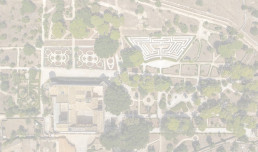
I’m eight years old and I’m following my father through the labyrinth of Donnafugata Castle, in the province of Ragusa. The walls are made of local white stone, dry-built and taller than an adult: inside you can’t see anything beyond the path in front of you. He’s ahead by one corner, maybe two, then I lose sight of him. I stop. I look up and see only sky, I look around and see only stone and dust. No point of reference, no breadcrumb trail.
That feeling… the stomach dropping, the breath shortening, the mouth suddenly going dry, wasn’t stupidity and it wasn’t distraction. It was what happens when a space doesn’t give you the tools to orient yourself.
A few years later I found myself in a ward of a well-known hospital in northern Rome, on a high floor, maybe the sixth, waiting for my parents. They were talking with a doctor in the corridor and I, to let them know I wanted to leave, got inside the open elevator cabin. Someone called the elevator from another floor. The doors closed, completely opaque, and I departed toward a floor I didn’t know. My parents had remained outside, with no audible signal, no voice, no illuminated number. Only movement.
I didn’t know what floor they were on. I didn’t know what floor I was on. The display was there, the floor numbers scrolling, but when the doors had closed I had focused on them, on the movement, on the descent. In panic you don’t read, you don’t memorize, you don’t reason: you watch what scares you. Outside, on every landing, the corridors all looked alike, with no visual reference to tell me where I was or allow me to reconstruct where I’d come from. I had no handhold, no idea how to get out of it.
The problem wasn’t the absence of information. It was the absence of a logic holding everything together.
In the end I went backward through every floor until I found them, helped by some kind people who had entered the elevator and had seen me in a panic.
When design fails, you’re saved only by the luck of meeting good people. It’s not acceptable for it to work that way.
Two very different spaces. The labyrinth, in fact, designed to disorient. The other, instead, should have helped me understand where I was, where I was going, how to go back, and it didn’t.
The labyrinth had an excuse. The hospital didn’t.
It’s not your fault
Yet we keep blaming ourselves. We should have paid attention, remembered the floor, not moved. As if orienting yourself in a complex space were an individual responsibility and not a design issue.
Sensitivity to these problems is growing in some contexts, but it remains uneven and insufficient. In hospitals wards are sometimes identified with combinations of letters and numbers that only make sense to those who work there, and floors are numbered following a logic understandable only to those who built them. In large corporate campuses each building often bears an alphanumeric code that means nothing to those arriving for the first time. In multi-story parking garages by the fourth floor you’ve already lost all sense of direction. These are all carefully designed spaces, in architecture, systems, furnishings, in which however no one has thought about how a person, who’s never been there before, will find their way.
The problem isn’t you. It’s that no one designed for you.
The UX you didn’t know you knew
Those who work in digital know this problem well. It’s called user experience, UX, and it’s the overall experience of a user interacting with an environment. For years companies have invested significant sums to understand how a user navigates a site, where they get lost, where they abandon, what frustrates them. Journey maps are built, interfaces are tested, obstacles are eliminated one by one, because it’s been understood that a digital environment that’s difficult to navigate loses users, loses credibility, loses value.
In physical spaces the same discipline exists, with the same conceptual tools and the same attention to real people. It’s called Environmental Graphic Design, EGD, and it’s the design of visual communication integrated into the built environment. It’s not signage in the bureaucratic sense of the term: it’s the design of the orientation experience of a real person, in flesh and blood, who enters a space they don’t know and must find their way.
A discipline, a method
At the center of EGD is wayfinding: the set of tools and design choices that allow people to orient themselves, understand where they are, find where they want to go and get there without stress. A well-done wayfinding project is invisible: you perceive it only when it’s missing, as in the elevator of that hospital, as among the white walls of that labyrinth.
As in digital, in wayfinding too you start from real people, not imaginary ones. Personas are built, profiles of the real users of the space, and their user journey is mapped, the path they take from entrance to destination. Decision points are identified, the physical points where a person must choose which direction to take: these are the most critical moments of the entire project, those in which a space can win or lose the people who inhabit it.
A good EGD project doesn’t just solve the orientation problem. It directly influences the sense of security of people: a readable space is a space where you feel comfortable, where you have the feeling of being expected and guided. It influences the perceived value of the place: a hospital that orients communicates care even before the patient meets a doctor, a corporate campus that reads at first glance communicates quality and organization right from the entrance. Signage is not an accessory: it’s an integral part of the identity and experience of a space.
The difference between a hospital that disorients and one that orients, between an opaque corporate campus and one that reads at first glance, between a parking garage where you wander and one where you immediately find the stairs, isn’t a matter of luck. It’s a matter of design: someone must think about it beforehand, long before the first sign is placed, walk that space, understand who will cross it and imagine every possible moment of doubt to resolve it in advance.
That someone exists. They’re called an Environmental Graphic Designer. In Italy there’s still too little talk about them.
A circle that closes
I would never have imagined, as a child lost among the white walls of that Sicilian labyrinth, that one day I would also do this for work: help people orient themselves. On the web, in corporate spaces, in pieces of the city. Transform complexity into clarity, disorientation into direction.
In the next article I’ll tell you what Environmental Graphic Design really is, why it requires skills that go well beyond traditional graphic design, and why a poorly designed space always costs more than a well-designed one.
Essential glossary
EGD – Environmental Graphic Design: the discipline that designs visual communication integrated into physical spaces. It includes wayfinding, place identity, signage and environmental interpretation.
Wayfinding: the set of tools and design choices that allow people to orient themselves in a space, find their destination and understand where they are at every moment of the journey.
UX – User Experience: the overall experience of a user in interaction with an environment, digital or physical. In the context of EGD it refers to the experience of orientation and navigation of a space.
User journey: the real path a person takes through a space, from entrance to destination, with all the moments of orientation, doubt and choice that compose it.
Personas: representative profiles of the real users of a space, built from observation and field research. They serve to design for those who really use the space, not for an abstract and imaginary user.
Decision point (decision point): the physical place where a person must choose which direction to take. It’s the most critical moment of wayfinding: if the right information is missing, the entire orientation project loses effectiveness
Does your space orient people or abandon them to themselves?
Let’s talk about it!