Google Search Console is updating with a new feature dedicated to multimodal searches, allowing site owners to analyze in more detail how their content is discovered when users use images during navigation.
The new reporting system is currently being rolled out globally and introduces a specific filter within the Search performance reports.
This update is particularly interesting for sites that make extensive use of visual content and represents a further signal of how the use of Google is becoming less tied to text alone.
What are multimodal searches?
When we talk about multimodal search, we refer to those modes in which the user does not exclusively use a word or phrase typed into the Google box, but also provides visual content.
A very simple example is Google Lens: instead of describing an object through a text query, the user can use the smartphone camera to show it directly to Google.
The new Search Console system includes data from various image-based search modes, including:
- Google Lens;
- Circle to Search on Android;
- images uploaded directly into Google Search;
- the “Search this image” feature available in Chrome.
A new filter in Search Console
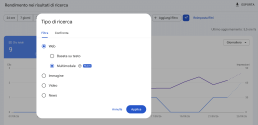
The update is accessible directly in the Search Console performance reports.
Within the search type filter, Google is introducing the possibility to distinguish traditional web searches from multimodal ones.
In this way, those who manage a site can separately analyze the performance generated by results in which an image is used.
Why is this update important for SEO?
The new report does not necessarily introduce a new ranking factor, but it allows for better analysis of user behavior that until now was more difficult to measure.
If the traditional mode follows the path user → keyword → results → site, the multimodal one adds a new possibility: user → image → Google interpretation → results → site.
In this scenario, images are no longer just aesthetic elements, but can become a further access point to a site. For this reason, it is important that they are relevant to the content, correctly associated with the page, and technically accessible to search engines. File name, alt text, and page context can contribute to providing useful information about their content.
The goal, therefore, is not simply to add more images or optimize them exclusively for Google, but to create visual content that is useful for users and easily interpretable by algorithms.
The question to ask is not just “Are the images on our site beautiful?”, but above all: “Can they be understood, found, and used correctly in search?”
The report also arrives in the context of AI features
Google has specified that data related to multimodal search will be available both in the search results performance report and in the report dedicated to generative AI features.
It is another indication of the evolution of Google Search toward experiences in which text, images, and artificial intelligence systems are used together.
For those involved in SEO, this means that the very concept of a “query” is becoming broader than the traditional keyword typed by the user.
Do you want to improve the visibility of your site’s images and exploit their SEO potential?
Our team can help you optimize visual content and develop an effective SEO strategy to increase your site’s presence in search results!